
How the Schroth Method Works
Elongate and Derotate Your Spine
Schroth Physiotherapy Exercises Are Customized for Your Unique Spinal Deformation.
- Correct spinal rotation and increase lung capacity with a rotational breathing technique.
- Help restore normal spinal position with pelvic corrections, breathing technique, and stabilizing isometric contractions.
- Improve your posture during routine daily living, not just during therapy.
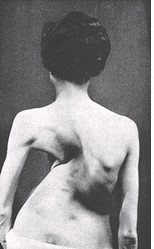
24-year-old woman with extremely severe scoliosis and atrophied left side.

After three courses of intensive Schroth treatment, each of 3 months duration.

After four in-patient courses. Treatment in this extraordinary case was significantly longer than usual.
The Definitive Handbook
on Schroth Exercises

Written by Christa Lehnert-Schroth, P.T. this book includes:
- Over 100 scoliosis exercises – with photos
- Treatments for 3, as well as 4-curve configurations, which the author discovered, and which are actually more common than many doctors realize
- Exercises for Scheuermann’s kyphosis, flatback, hollow-back syndrome (hyperlordosis), lumbar kyphosis, spondylolisthesis, and related pathologies
"I have remained an adherent of Scroth therapy right up to the present day. I haven't been sick in bed for one day in 50 years, and I'm also not under doctor's care or on any drugs. Despite my 88 years and severe scoliosis, I'm still fit."
Georg S.
Scoliotic Imbalances and Rotations
For at least fifty years, clinical studies of scoliosis frequently have reported paraspinal muscle imbalances of strength, diameter, length, fiber type, or electromyographic activity. They support the Schroth thesis that scoliosis always involves asymmetrical muscle groups in the back and elsewhere, which in normal bodies are more evenly symmetrical.
In a typical scoliotic configuration, depicted at right, back musculature pulls lower ribs so that the lumbar (abdominal) region rotates laterally, downwards, and backwards.
To maintain the torso’s upright and forward orientation, the thoracic (chest) region must twist back in the opposite directions, and the cervical (neck) area responds with a third abnormal twist. Other imbalances are often present in the legs and feet. The resulting eccentric loads predispose the scoliosis to a vicious cycle of progression with unpredictable outcome.
In its effort to reverse the scoliotic spinal rotations, the Schroth method of scoliosis exercise therapy addresses all three planes — sagittal, frontal, and transverse. This means that correction needs to occur not only from side to side and front to back, but also longitudinally: that is, the spine which has shortened because of rotation must also be lengthened. Hence the Schroth method’s designation as “three-dimensional” therapy.

Correcting Scoliotic Posture
The Schroth method places great emphasis on conscious correction of posture during routine daily living, not only during strenuous exercise periods. Each patient learns about her or his own body and what she/he has to do in order to reverse and control abnormal posture so that improved posture becomes a habit.
The following photos show a female patient with a very severe case (over 100-degree curve).
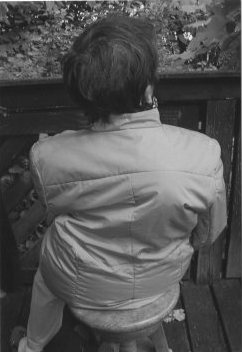
Patient's natural posture with more than a 100-degree curve
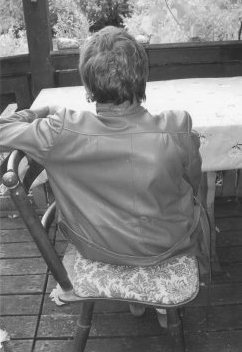
Conscious posture correction
On the left she slumps, not thinking about her posture, and unconsciously allows the three torso sections to become exaggerated and clearly recognizable. Her thoracic section is clearly twisted against the lumbar region, and her shoulder-cervical region compensates with a counter-rotation against the thoracic section. This reversion to faulty, scoliotic posture is akin to performing a wrong exercise. Left uncorrected, the posture could allow the deformity to progress further.
In the photo on the right, she corrects her posture as far as possible. She uses the chair’s back rest to widen her concave left side and fills it out further with the Schroth rotational breathing technique. By correcting her posture, she not only improves her appearance, becoming somewhat straighter and taller, but also increases her lung capacity and reduces the tendency for posture-related pain to develop.
Schroth Treatment Goals
The scoliosis exercises are designed to reverse all of the abnormal curvatures with a variety of means, based upon the therapist’s analysis of a patient’s muscle imbalances. Christa Lehnert-Schroth writes in her book:
Scoliosis is characterised by a more or less pronounced change in the balance of forces, starting already in the feet, legs and hips, with inequality of muscles in terms of length and size. The greater the deviations from the midline, the longer the affected muscles become and the more volume is lost. They become flaccid and finally inactive. They lose their supportive function. Shape changes are only possible because the muscles permit them to happen. They become longer or shorter depending on the direction in which the trunk is moved and rotated. In other words, deviations of the trunk to the side or backwards can only develop if the corresponding supportive muscles give way and become elongated. Therefore, treatment must improve posture so that the body can regain its original vertical axis. This can only happen by developing and training the corresponding muscle groups responsible for upright posture. To restore muscular balance, those muscles that have grown longer must be shortened and those that have become shorter must be lengthened. In order for these to be able to hold the spinal column and ribcage in their normal vertical position again, they need to be strengthened -- and on both sides. It is absolutely essential that the inactive, shortened muscles perform strength work in the lengthened state.
[pp. 42-43]
The basis of correction is a properly aligned pelvis. A scoliotic pelvis is often not only shifted laterally but also tilted and rotated. Therefore the spine, which attaches to the pelvis via the sacrum, has a misaligned foundation. The Schroth method first addresses the patient’s pelvis position with five corrections.
The treatment can then focus on spinal elongation, and on derotation by means of individually designed scoliosis exercises.
One of the primary Schroth tools is strengthening exercises tailored to the individual patient. Another, the unique rotational breathing technique, focuses on vertebral derotation using the ribs as levers, as well as on increasing the patient’s vital capacity. Read about Exercises for Scoliosis to see a few sample Schroth method scoliosis exercises designed for a specific patient.
Find Out How the Schroth Method for Scoliosis Can Help You
Educate yourself on the exercises that therapists use to treat scoliosis

Additional Resources
Why Schroth Method?
- Reduces Pain
- Stops Curve Progression
- Increases Lung Capacity
Without the need for surgery.
Try Schroth Exercises first!
The information and links to therapists provided on this site are intended for informational purposes only. While we strive to ensure the accuracy and currency of our listings, we cannot guarantee that all information is up-to-date or that all therapists are currently accepting new clients. We strongly recommend that you perform your own due diligence by conducting a thorough Google search and verifying the credentials, availability, and suitability of any therapist you wish to contact. This site does not endorse or recommend any specific therapist and assumes no responsibility for the services provided by any listed professional. Your use of this site and reliance on any information provided is solely at your own risk.