|
|
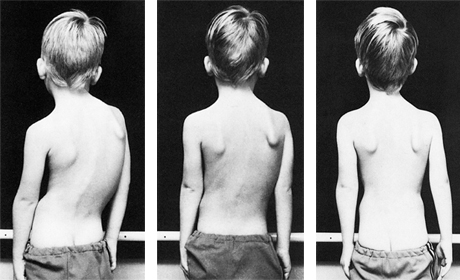
5-year-old
boy, scoliosis resulting from polio (left).
After 3 weeks of intensive Schroth treatment (center). After 8 weeks of Schroth scoliosis exercise therapy (right). |
THE SCHROTH METHOD
The Schroth method is a physiotherapeutic treatment system which uses isometric and other exercises to strengthen or lengthen asymmetrical muscles in a scoliotic body. Its goals are to halt progression of abnormal spinal curvature, and in the best case to reverse the curves.The system was developed in the 1920s by Katharina Schroth (1894-1985), and further developed by her daughter Christa Lehnert-Schroth. By the 1960s, the Schroth method had become the standard non-surgical treatment for scoliosis in Germany. Schroth treatment is currently supported in Germany by the federal health insurance system, and German orthopedic surgeons routinely refer patients for Schroth scoliosis exercise therapy.
THE SCHROTH METHOD
HELPS PATIENTS TO:
- Halt curve progression
- Reduce pain
- Increase vital capacity
- At least partly reverse abnormal curvatures
- Improve posture and appearance
- Maintain improved posture lifelong
- Avoid surgery
In most cases these goals are achieved, at least in part. See the
Clinical Studies
page for published reports on results obtained from hundreds of
patients at Schroth clinics in Germany, Spain, and Turkey.
Only a small percentage of
Schroth patients elects to undergo surgery. This is all the more
remarkable
since patients at the Katharina Schroth Klinik in Germany are usually
the more serious cases, referred by orthopedists.
SCHROTH
SCOLIOSIS EXERCISES WORK - BECAUSE THEY ADDRESS THE REAL CAUSE
All scoliosis cases involve asymmetrical muscles. A
scoliotic spine twists abnormally due to strength and bulk imbalances
among muscle groups in the back and elsewhere (such as lower
extremities) that are supposed to be
equal. For whatever reason, some muscles on one side of the back grow
stronger than the opposing group on the other side and pull harder. The
weaker ones cannot maintain a balance, so the scoliosis cycle begins
and gradually worsens under the asymmetrical loads. How the spine initially began to twist (whether due to muscle degenerative disease or unknown causes) is less important than recognizing the imbalances. Identify the imbalances and you can treat the problem. See the scoliosis exercises page.
An effective exercise treatment of scoliosis must first diagnose which muscle groups in a patient's body are too weak, and which are overdeveloped and tight. Then the therapist designs a program to restore normal balance. Each person's scoliosis is somewhat unique, so a therapist tailors exercises individually.
The regimen of muscle-strengthening and stretching exercises aims to derotate and elongate the spine back into its normal position. The patient must do the scoliosis exercises for about 1/2 hour daily. Patient compliance is extremely important, and it's hard work, but consider the benefits. The Schroth method gives a patient the knowledge and tools to control her or his own postural health, lifelong.
COMMENTS
BY HEALTHCARE PROFESSIONALS
For some fascinating
comments by orthopedists and
physical therapists on Christa
Lehnert-Schroth's practice and the German editions
of book, see the Reviews
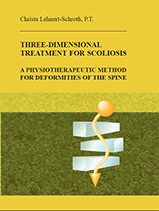
page. Buy the new English translation of the book here.